

CROSS-CULTURAL EXCHANGE
Exploring the subcultures of Indian Aesthetics and 90s Hip-Hop Fashion
HYBRIDITY AND THE THIRD SPACE: 90S HIP-HOP INDIAN AESTHETICS
Hybridity and subculture are deeply intertwined in the context of Western adaptation. It is not uncommon for two subcultures to find alignment, their shared realities converging in unexpected ways. This cross-cultural exchange is often framed as appropriation — a word that typically carries negative connotations, suggesting imitation without respect, rooted in a colonial mindset. But what does exchange look like when it occurs between two subcultures that both exist within a dominant culture by force? How do these subcultures represent resilience, respect, and innovation when their worlds collide?
Artist Yinka Shonibare explores cultural identity, colonialism, and post-colonialism throughout his work, arguing that because of colonialism there is no singular way to represent oneself. Post-colonial history has given rise to what he calls the "post-colonial hybrid" (Shonibare, 1996). Theorist Homi Bhabha conceives this thinking: "The importance of hybridity is not to be able to trace two original moments from which a third emerges, rather hybridity is the third space which enables other positions to emerge" (Bhabha, 1990, p. 211). This third space is born from two colonized groups navigating the Western world together.
Indian influence has been present in hip-hop since the 1990s — first through sampling by artists like Jay-Z and A Tribe Called Quest, and most prominently in Missy Elliott and Timbaland "Get Your Freak On," which features tabla, tumbi (1), and Punjabi vocal snippets (Hankins, 2011). Rather than assuming these cultural connections stem from mere infatuation, I argue that these subcultures pair because of shared conflicts, ones embedded in both music and fashion. These codes function as what Kobena Mercer calls "encoded signifiers of resistance" (Mercer, 2016, p. 146). This photo essay explores that argument by juxtaposing 90s hip-hop aesthetics with Indian visual culture.
Artist Yinka Shonibare explores cultural identity, colonialism, and post-colonialism throughout his work, arguing that because of colonialism there is no singular way to represent oneself. Post-colonial history has given rise to what he calls the "post-colonial hybrid" (Shonibare, 1996). Theorist Homi Bhabha extends this thinking: "The importance of hybridity is not to be able to trace two original moments from which a third emerges, rather hybridity is the third space which enables other positions to emerge" (Bhabha, 1990, p. 211). This third space is born from two colonized groups navigating the Western world together.
Black Americans and Indians share a foundational struggle: colonialism under European rule. Britain governed India for approximately 200 years (c. 1757–1947), from the East India Company's victory at the Battle of Plassey through the British Raj, concluding with Indian independence in 1947 (Sandhu, 2015). India's diaspora extends strongly into the Americas, particularly the Caribbean. Following the abolition of slavery in the nineteenth century and through World War I, British, Dutch, and French governments imported over 500,000 Indians to Caribbean sugar colonies as indentured servants (Roopnarine, 2009). As Indian laborers arrived in greater numbers across European colonies, so did restrictions. Around 1910, exclusionists in California began pushing for a "Hindu" exclusion bill (2) modeled after the Chinese Exclusion Act (Munshi, 2022). Many of the first Indians to reach the United States were students and political exiles already active in resistance against British rule. In 1913, a coalition of students and workers established Ghadar (3)— meaning "mutiny" or "revolt" — with the explicit goal of ending British colonialism in India (Munshi, 2022). These immigrants arrived identifying with American ideals of independence, only to face exclusion, exploitation, and routine humiliation. Over time, many began to recognize that they had more in common with Black Americans than with the dominant culture — a shared struggle against white supremacy that transcended geography.
Identity emerges from the collective consciousness of groups sharing common community and culture (Premdas, 2001, p. 4). For India's diaspora, retaining that identity amid displacement was both an act of survival and resistance. This photo essay sits at that intersection, exploring appropriation, post-colonialism, and the third space through fashion.
“The importance of hybridity is not to be able to trace two original moments from which a third emerges, rather hybridity is the third space which enables other positions to emerge”
- Homi Bhabha

HIP-HOP IN REGALIA
This model is adorned in Indian finery — a Maang Tikka (4) and Jhumka earrings with a choker (5). These pieces symbolize beauty, grace, and matrimonial union, traditionally worn by brides and at festive occasions, and have since evolved into broader fashion statements.
RACE AND CLASS COLLISION
The model negotiates between 90s hip-hop and Indian aesthetics, pairing a baggy silhouette with Indian regalia. The fine jewelry signals formality while the casual styling invites a conversation about hybridity across class and race.


PIERCING BEAUTY
Cross-cultural exchange is made explicit through the combination of a New York Yankees cap and Jhumka earrings. A versatile brass choker and a direct, unflinching gaze complete the image — assertive and deliberate.
HIP-HOP & DESI-CHIC
Western, hip-hop, and Indian influences collaborate to create a third space. The model embodies the "Desi chic" aesthetic (6) — modern silhouettes meet Western clothing, while an Indian-patterned fabric draped across her shoulder evokes a dupatta (7). Her yoga pose pays homage to the practice's country of origin.


LOST IN TIME
The model continues negotiating cultural and conceptual shifts. A custom Los Angeles Dodgers cap speaks to hip-hop's geographic diversity, while Indian earrings and a head scarf maintain a continuous visual thread.
INDO-AMERICAN
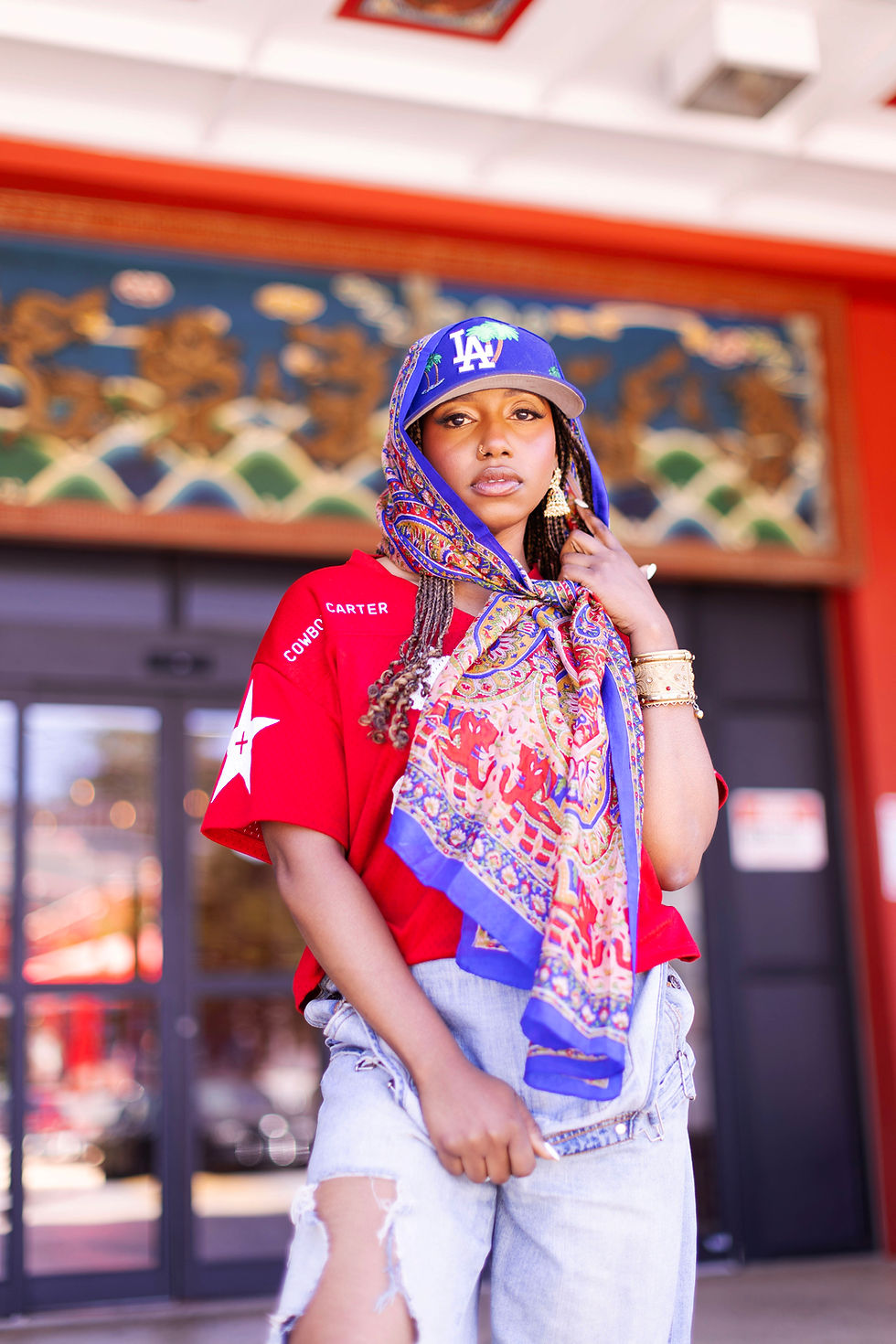
A full-body frame reveals deeper Western influences — a Beyoncé Cowboy Carter jersey paired with overalls — but the purposeful placement of an authentic Indian scarf reframes the image, telling a story of two subcultures in conscious conversation.

REGAL WITH AUTHORITY
Here the focus returns to Indian representation. The model's chin is lifted, her posture regal, her presence commanding. The ornamentation is not costume — it is identity worn with intention.
AND STILL... I SMILE
With resilience, respect, and innovation comes laughter and love. Indian Americans and African Americans share similar experiences of discrimination and disrupted heritage. Both communities have endured profound rupture — yet find common joy in fashion, music, and human connection.

CONCLUSION
Cross-cultural exchange reflects the modernism, post-modernism, and visual complexity of diasporic culture in the West. There is no such thing as cultural oneness in a shared space shaped by colonial dominance. What emerges instead is what theorist James Clifford calls "traveling culture" — identity uniquely expressed through lived experience (Clifford, 1992). What does it really mean to be "Black enough" or "Indian enough"? As Shonibare asks: "Is there such a thing as pure origin?" (Shonibare, 1995). The answer, illustrated across these images, is no — and that is not a loss. It is the third space. It is where we live.

model/ stylist: Imari Turk
creative director: Bree Kelly
photographer: Mike Lu
authentic Indian jewelry by
mahadevi studio


WORK CITED
Bhabha, H. K. (1990). The third space: Interview with Homi Bhabha. In J. Rutherford (Ed.), Identity: Community, Culture, Difference (pp. 207–221). Lawrence & Wishart.
Clifford, J. (1992). Traveling cultures. In L. Grossberg, C. Nelson, & P. Treichler (Eds.), Cultural Studies (pp. 96–116). Routledge.
Gilder Lehrman Institute of American History. (n.d.). Indians in the United States: Movements and empire. https://www.gilderlehrman.org/history-resources/essays/indians-united-states-movements-and-empire
Hankins. (2011). So contagious: hybridity and subcultural exchange in Hip-Hop’s use of Indian samples. Black Music Research Journal, 31(2), 193. https://doi.org/10.5406/blacmusiresej.31.2.0193
Mercer, K. (2016). Diaspora Aesthetics and Visual Culture. In Travel & See: Black Diaspora Art Practices since the 1980s (pp. 227–247). Duke University Press. https://doi.org/10.1215/9780822374510-017
Munshi, S. K. (n.d.). Indians in the United States: Movements and empire. Gilder Lehrman Institute of American History. https://www.gilderlehrman.org/history-resources/essays/indians-united-states-movements-and-empire
Premdas, R. (2001). Identity, ethnicity and the Caribbean homeland. University of the West Indies Press.
Roopnarine, L. (2009). Indo-Caribbean indenture: Resistance and accommodation, 1838–1920. University of the West Indies Press.
Sandhu, S. (2015). The British Empire in India: A history. Penguin.
Shonibare, Y. (1996). Fabric and the irony of authenticity. In N. Papastergiadis (Ed.), Mixed belongings and unspecified destinations: INIVA annotations 1 (p. 40). Institute of International Visual Arts.
Sandhu, A. (2015). Indian Fashion: Tradition, Innovation, Style. Bloomsbury Publishing.
© 2026 Bree Kelly
FOOT NOTES
1. A tabla is a pair of hand drums from the Indian subcontinent. Tumbi (or toombi) is a traditional, high-pitched, single-stringed plucked instrument from the Punjab region of India.
2. Hindu exclusion bill" often refers to contentious legislation or proposals that Hindu groups and advocates claim unfairly target, profile, or marginalize Hindu individuals and organizations, often under the guise of anti-discrimination.
3. The Ghadar Movement was a 1913, U.S.-based revolutionary effort by Indian immigrants, largely Punjabi Sikhs, to overthrow British rule in India through armed revolt.
4. A maang tikka is a traditional Indian headpiece worn along the central hair parting, featuring a decorative ornament that rests on the forehead.
5. Dangling Indian earrings are most commonly called Jhumkas (or Jhumkis).An Indian choker is traditionally called a choker, necklace, or specifically a hasli (Hindi/Punjabi), thushi (Marathi), or attigai (Tamil).
6. Desi-chic (or Indian-chic) is a fusion fashion style blending traditional Indian garments—like sarees, kurtas, or lehengas—with modern silhouettes, western clothing, or contemporary styling to create a polished, versatile look.
7. Dupatta is a scarf or stole worn around or over the head– usually worn with a salwar kameez, Also referred to as chunni or odhni.
© 2026 Bree Kelly